
Historic Elimination of Expert Panels Reshapes Federal Decision-Making
If you’ve bid on federal grants or contract support that relies on agency expertise, pay attention, the government’s usual “expert check” is shrinking fast. That changes who decides what gets funded, how rules are written, and how predictable agency decisions will be going forward.
What’s happening
Government agencies have usually relied on many advisory panels made up of scientists, industry experts, and other specialists to review research, grant applications, and help with technical rules. But recently, these panels are being cut back quickly. Reports show that about 160 federal advisory committees have been officially closed so far, which is much faster than usual.
The cuts aren’t happening evenly. The Department of Health and Human Services (HHS) has lost a lot of panels, and technical committees at places like the Bureau of Labor Statistics have been affected too. Some agencies have even disagreed with these cuts.
Why this matters to federal contractors: fewer formal expert panels means less transparent, less predictable technical review and a greater chance that decisions will be made inside smaller, politicized circles or by ad-hoc groups that may not be subject to the same public-access rules.
Real examples and the practical fallout
-
Grant review changes: Some HHS panels that used to review grants with clear rules have been shut down. Now, ad-hoc groups handle this work, which makes scoring and priorities less consistent and less transparent.
-
Technical models and data quality at risk: BLS technical committees that helped design statistical approaches and respond to funding shortfalls were among the committees ended, a direct hit to agencies that rely on outside technical expertise.
-
Decision-making shifts:Where agencies once had a visible, deliberative input stream, the absence of panels risks concentrating decision-making in political appointees or internal staff, which can increase legal risk and unpredictability for contractors. Experts say this could make agency actions less durable in court and harder to plan for.
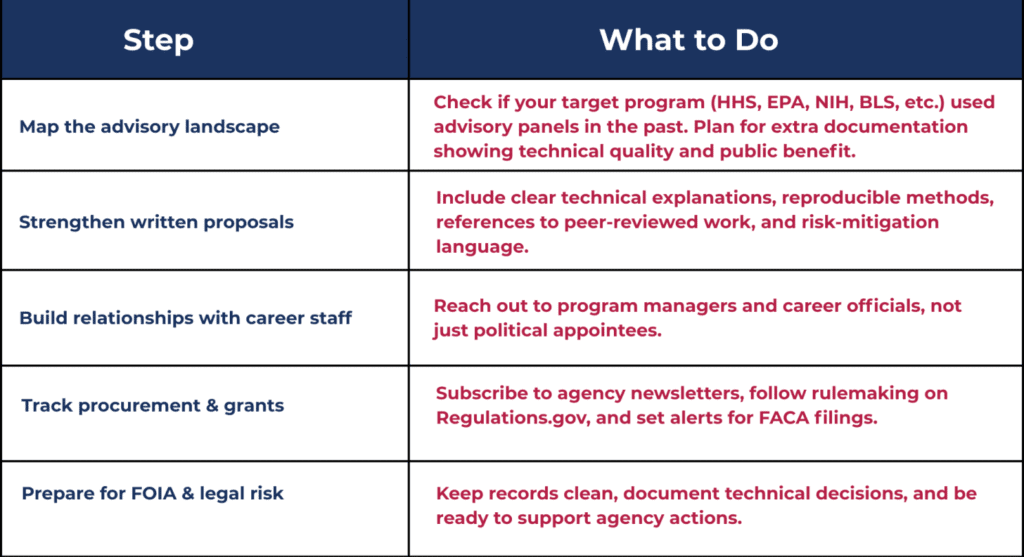
Actionable steps for contractors
Opportunities hidden in disruption
When processes change, so do openings. Agencies that lose broad advisory input may be more open to pilot partnerships, contractor-led field demonstrations, or staged proof-of-concept work to fill technical gaps. If your firm can offer reproducible pilots, independent evaluations, or turnkey methods that reduce agency dependence on outside committees, you become more valuable, not less.
Also, former panel members (academics, retired agency scientists, industry specialists) are still around. Recruiting these experts as consultants or subcontracted reviewers for your proposals can lend credibility and help replicate the technical depth panels used to provide.
Conclusion
The rapid elimination of federal advisory panels is reshaping how decisions are made across government agencies, creating both challenges and opportunities for contractors. While fewer panels mean less transparency and potentially less predictable decision-making, contractors who adapt by strengthening their proposals, building relationships with career staff, and offering independent technical solutions can gain a competitive edge. By understanding the shifting landscape, documenting technical rigor, and leveraging expert networks, contractors can not only navigate the disruption but also position themselves as indispensable partners to agencies navigating a leaner advisory environment. Staying proactive, informed, and flexible will be key to thriving in this evolving federal contracting ecosystem.