
8a Certification Rules Just Got Changed. What Small Business Needs To Know
Introduction
Is your SBA 8(a) certification protected under the 2025 rule changes — or do you risk losing access to set-aside work?
If you’re a socially or economically disadvantaged business competing in the federal marketplace, these updates could reshape how you qualify and maintain your 8(a) status. The Small Business Administration’s new compliance measures aim to strengthen program integrity, but they also raise the bar for documentation, local presence, and verification.
This blog unpacks every major change, explains what’s driving these updates, and guides small contractors on how to stay ahead in today’s evolving federal contracting space.
Why the changes matter for SBA 8(a) Certification
For small businesses seeking federal contracting advantage via the 8a certification, these updates represent a meaningful shift. Rather than “set it and forget it”, the program now demands more detailed documentation, more tangible presence, and stricter eligibility checks. The result: firms that prepare ahead will gain an edge, while those that rely on prior assumptions may face surprises.
Here’s a breakdown of what’s new, what’s driving these updates, and how small businesses can stay ahead.
1.The Return of the Bona Fide Place of Business Rule
The most discussed change in 2025 is the reinstatement of the Bona Fide Place of Business (BFPOB) rule a development with major implications for 8(a) construction firms.
What the Rule Requires
The updated rule mandates that 8(a) participants maintain a physical office or operational presence within the state or region where a contract is performed. Previously, virtual or remote operations often met SBA requirements. That flexibility is now restricted.
Why SBA Brought Back This Rule
-
To ensure legitimate local business participation.
-
To discourage remote-only firms from bidding on location-specific set-asides.
-
To promote fair competition and job creation within local economies.
What Small Businesses Should Do
-
Verify if your current address meets the BFPOB rule.
-
Consider setting up satellite or rented offices in key regions.
-
Keep verifiable records like lease agreements or utility bills to confirm your location.
For small businesses used to remote models, this marks a major shift. Preparing early ensures you remain eligible for geographically restricted contracts.
2. Proving Social Disadvantage under New SBA Guidance
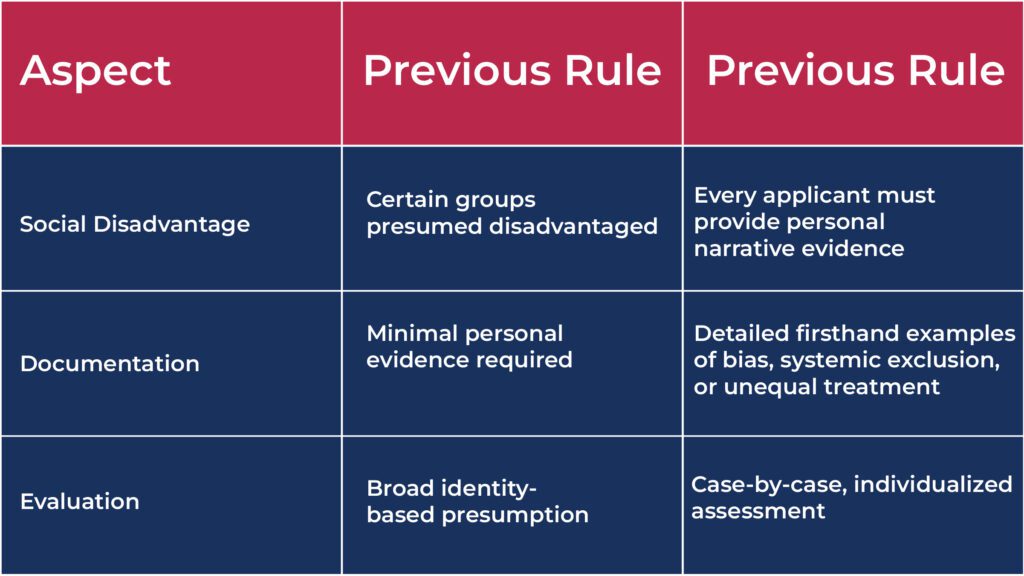
A major adjustment in the 8(a) certification process concerns how social disadvantage is proven.
What This Means for Applicants
You must now submit a credible personal narrative explaining how social disadvantage directly impacted your business opportunities.
The narrative should include:
-
Specific instances of discrimination or bias.
-
Effects on your educational, professional, or entrepreneurial experiences.
-
Proof that the disadvantage is rooted in long-term systemic barriers.
Why This Matters
By removing automatic presumptions, the SBA ensures fairness and authenticity in the 8(a) program. However, it also means documentation quality has become central to approval.
Small Businesses should work with experienced consultants or writers to craft well-documented, evidence-based narratives that align with SBA standards.
3. Certification Timelines and Heightened Review Process
The SBA has acknowledged longer application and re-certification timelines due to increased scrutiny levels.
Key Trends in 2025
-
A 30% spike in 8(a) applications since new rules introduced.
-
Additional review layers for verifying ownership, control, and social disadvantage.
-
Extended processing times that may delay access to solicitations.
Practical Tips
-
Begin your renewal process 90–120 days before expiration.
-
Prepare all supporting documentation early to avoid backlogs.
-
Keep backup bidding strategies (e.g., partnering or pursuing unrestricted opportunities) in case certification delays impact eligibility.
Businesses relying heavily on 8(a) contracts should plan financially and strategically for temporary disruptions during the review process.
4. FAR Part 19 Alignment and Upcoming Consistency Changes
The Federal Acquisition Regulation (FAR Part 19) is undergoing revisions to align more closely with SBA’s updated 8(a) requirements.
Key Outcomes to Expect
-
Consistent eligibility enforcement across all federal agencies.
-
Improved clarity for contracting officers when evaluating small business set-asides.
-
Strengthened auditability and accountability in 8(a) awards.
Once integrated, this update will help ensure federal agencies uniformly apply SBA rules, reducing the confusion and inconsistencies that previously plagued multi-agency contracting efforts.
Benefits for Small Businesses
-
Fewer compliance ambiguities.
-
Clearer proposal standards.
-
Greater credibility and transparency in 8(a) participation.
5. The Purpose Behind the 2025 SBA Updates
Behind every rule change is a broader SBA goal: program integrity.
Audits in recent years found instances of misuse, such as businesses retaining 8(a) benefits after ownership changes or losing disadvantaged status. The SBA’s 2025 reforms aim to close these gaps.
Core Objectives
-
Ensure only eligible firms remain certified.
-
Prevent fraudulent ownership or control claims.
-
Reaffirm the program’s mission to uplift truly disadvantaged entrepreneurs.
These measures strengthen public confidence and maintain the integrity of the federal small business ecosystem—ultimately benefiting legitimate 8(a) contractors in the long run.
6. Preparing Your Business for Compliance and Growth
Adapting to these changes doesn’t have to be daunting. Proactivity is key.
Compliance Checklist for Small Businesses
-
Review ownership, size, and control qualifications regularly.
-
Gather all supporting documentation, including your social disadvantage narrative, as early as possible.
-
Maintain or establish a physical office presence aligned with the Bona Fide Place of Business rule.
-
Monitor SBA regulatory alerts and agency guidance updates.
-
Consult SBA-certified advisors, proposal experts, or compliance consultants.
Strategic Mindset
Think of these changes not as barriers but as filters that highlight truly prepared and authentic businesses. Contractors who adapt quickly will stand out as trusted, compliant partners to federal agencies looking for reliable 8(a) participants.
Conclusion
The SBA 8(a) certification updates aren’t designed to restrict access—they aim to safeguard fairness, accountability, and clarity in federal contracting.
For small, disadvantaged businesses, these rule changes are both a challenge and an opportunity. With stronger documentation, proactive planning, and informed guidance, your company can remain fully eligible while positioning itself as a trusted federal partner.
The future of 8(a) participation belongs to those prepared to prove authenticity, maintain compliance, and embrace the evolving standards shaping the federal small business landscape.
Stay ahead of the 2025 SBA updates
Schedule a free consultation with our GovCon experts today